CASE STUDIES
Case Study 1
Waders of Britain & Ireland

Brief
The identification of waders can be a challenge for many reasons e.g. plumage changes, mixed species groups etc. The aim of this project was to create aids to help beginners and improvers to accurately identify wader species as they are seen in the field, frequently at a distance in relatively poor weather conditions, using binoculars or a telescope.

Approach
To provide an integrated suite of resources. This included a comprehensive, weather-proof, fold-out guide (WildID) supported by a digital multi-access identification key (Identikit) and an online flashcard learning aid (Quizlet).

Outcome
Including clear illustrations and silhouettes showing the crucial features; identification is principally based upon body shape, especially bill length and bill curvature. Body size, behaviour, calls, time of year, location and habitat are also important and are included. In particular, the fold-out guide enables easy comparison between species and provides a practical and portable aid for use in the field.
© Keith Offord
© Keith Offord
Case Study 2
Beetle Families of Britain & Ireland
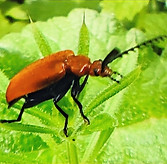

© Courtenay Holden
Brief
There are over 4,000 beetle species known to occur in Britain and Ireland, arranged into 102 taxonomic families. The aim of this project was to develop a set of tools to help beginners and improvers to accurately, and rapidly, place beetles into their correct family; most likely using a hand lens or microscope in the classroom or study.
Approach
To provide a combined print and digital package. This included a digital multi-access identification key (Identikit) supported by a fold-out guide (AIDGAP) and an online flashcard learning aid (Quizlet) to introduce users to the major beetle families.

Outcome
Whilst some distinctive beetles may be identified with an Auto-identification App, many species are too similar and cannot be reliably separated using image recognition alone. The digital multi-access identification key provides reliable output across the species range and allows users a high degree of flexibility, especially in terms of the identification characters needed to achieve a result.